Colosseum Codex: Cofounder Matching, Devnet Restart, Hydra
Colosseum Cofounder Matching, MLH 10 Days of Solana, Anza Devnet Feature Deactivation, Hydra Crank


Here's what's featured in this week's issue:
- Colosseum's Cofounder Matching platform is now open to the public
- MLH hosting 100 Days of Solana hands-on challenge series
- Anza restarts Devnet to deactivate features not on mainnet-beta
- Introducing Hydra permissionless Solana crank for scheduling instructions
🤝 Colosseum Cofounder Matching
Colosseum launched a cofounder matching platform for crypto founders, open to any serious applicant from its existing community regardless of prior hackathon or accelerator participation. The platform draws from founders across 150+ countries.
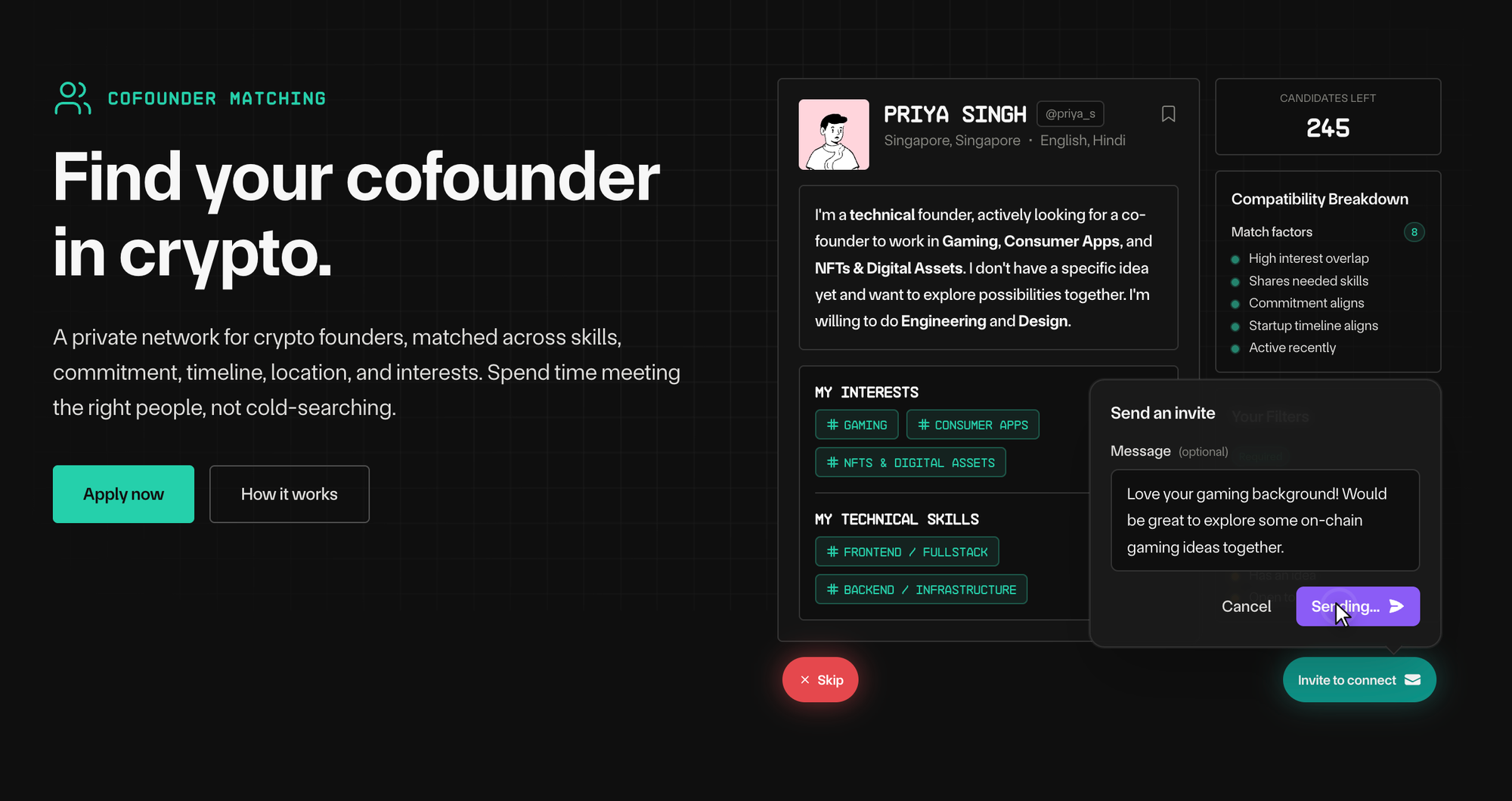
Applicants complete a detailed questionnaire covering work style, equity expectations, commitment timeline, and dedication level. An algorithm ranks candidates across multiple dimensions — skills and roles, commitment level, location, vertical interests, and mutual compatibility. Every application goes through a manual human review pass before matches are surfaced.
Customizable filters let applicants set both required and preferred criteria, so a full-time founder seeking a technical cofounder in a specific vertical isn't matched with someone treating it as a side project. When two candidates mutually match, Colosseum opens a private channel with contact details exchanged.
Announcing Colosseum Cofounder Matching
📅 100 Days of Solana
100 Days of Solana is a structured challenge series running April 20 through July 26, 2026, designed to take developers from no Solana experience to shipping real applications. Organized by MLH, it targets developers who understand web development but haven't found an entry point into onchain building.
The 100 days are divided into four Epochs:
- Reading and Writing Data
- Owning and Moving Data
- Building Programs and Contracts
- Shipping and Exploring.
Within each Epoch, week-long arcs focus on a specific topic, following a fixed daily rhythm: Monday introduces the concept, Tuesday builds it, Wednesday stretches further, Thursday reinforces, Friday experiments, Saturday documents on DEV.to, and Sunday reviews others' work.
Four challenges are live so far: generate a keypair and fund it with devnet SOL, create and persist a wallet with balance tracking, understand the SOL/lamports model in code, and connect a browser wallet with live address and balance display. Each builds directly on the prior day.
Discussion runs in the #100-days-of-solana-discussion channel on the MLH Discord.
🔄 Devnet Restart and Block History Clarification
Anza executed a planned Devnet halt on April 14 to deactivate three features that had been active on Devnet since 2022 but never activated on Mainnet-Beta. Removing them brings the two clusters closer to parity so developers testing on Devnet before Mainnet-Beta deployment get a more accurate environment.
The three deactivated features are:
- libsecp256k1_verify count check
- blake3 syscall
- increased transaction account lock limit.
Devnet programs relying on any of these will see behavior changes, which is intentional. The change surfaces dependencies on functionality that isn't available on Mainnet-Beta.
The restart introduced two block history issues. Slot 455406516 was created for the restart snapshot but not stored in the blockstore, making it unavailable to RPC consumers. Slot 455406517 was stored and finalized but contained an incorrect previousBlockhash field due to the missing parent.
Both have been corrected in long-term storage.
April 2026: Devnet Planned Restart and Block History Clarification
⏰ Hydra Solana Crank
Hydra is a permissionless Solana crank from MagicBlock for scheduling instructions with minimal overhead. Blockchains are event-driven by nature, and scheduling execution reliably is a recurring problem for protocol builders. Existing tools like Clockwork and TukTuk address this with broader, more general-purpose runtimes, but Hydra takes the opposite approach.
At 464 CU of overhead per execution, it's built to be lean. The cranker submits a 2-instruction transaction: Trigger verifies the next instruction against bytes stored on the crank PDA at create time, collects a reward, and advances state. Scheduling logic is committed at creation, and because the endpoint accepts any signer, no permissioned runner is needed.
Hydra is a minimal primitive scoped to oracle ticks, AMM pokes, public crank() endpoints, and settle/liquidation flows, where a lightweight, trust-minimized scheduler is enough.
Want early access to the latest products launching from Colosseum?
We're looking for alpha testers to be among the first to try what we're building!
⚡ Quick Hits
Fix your Project's Communication for Colosseum in 3 Steps - @ozgsol
Circuit breakers for DeFi programs on Solana - @mmdhrumil
Quicknode adds ~50 Quasar program examples - @QuicknodeSolana
Introducing SOLAUDD Solana Developer Program - @SuperteamAU
Applications for Cohort 5 of the Solana Incubator are now open - @incubator
⚙️ Tools & Resources
vector-react-demo is a React/TypeScript demo UI for Vector, a Solana primitive that authorizes transactions using offchain Ed25519 signatures. The signer creates an offchain signature, the program verifies it matches the transaction digest computed onchain, executes the authorized instruction, and advances its seed to prevent replay attacks.
Intelleum (private beta) is an MEV intelligence layer for Solana that detects sandwich attacks, JIT, and arb before they execute, then reroutes trades away from toxic venues in real time. Built for routers, LPs, DEXes, and infra teams.
Solana Bytes is a browser tool for visualizing Solana account data. Paste any address and get an interactive, color-coded hex dump with educational tooltips on every field region. Supports mint accounts, token program ELF, Token-2022, stake accounts, and NFT metadata.
quasar-escrow is a full-stack Quasar template that ships the Escrow program from the Quasar docs alongside a React UI.
soltrace is a Rust event indexer for Anchor programs that decodes emitted events using IDL specs, with no manual configuration required. It supports real-time tracking via WebSocket and historical backfilling via RPC, with storage backends for SQLite, PostgreSQL, and MongoDB.
saep is an onchain framework for autonomous agent coordination on Solana, covering agent registration, constrained treasury management, task marketplace with escrow, and ZK proof verification for work completion.
👩🔧 Get Hired
- Rain is hiring a Senior Implementation Manager
- Phantom is hiring a Senior Product Manager - Agentic Trading
- Quicknode is hiring a Senior Software Engineer
- Helius is hiring a Staff Backend Engineer, Gatekeeper
📅 Event Calendar
Workshop: Build Your Solana Product Like a Colosseum Winner, Virtual, April 28
Superteam Pakistan workshop featuring Sofian and Ansel, co-founders of legends.fun and Colosseum hackathon winners, covering product approach, feature prioritization, and common pitfalls during hackathon builds.
🎧 Listen to This
The Index Podcast
Plish, co-founder of Hylo, breaks down the protocol's zero-external-dependency stablecoin architecture (hyUSD, sHYUSD, xSOL), why DeFi composability is a security liability, how a 4-person team uses Claude to punch above their weight, and what's coming in V2.
The Safer Way to Build DeFi on Solana — Plish, Co-Founder & CEO of Hylo
Follow me on X!
Thanks for reading ✌️
I hope you found something useful here! If you have any suggestions or feedback just let me know what you think.