The Volta Prize, Colosseum, and Hackathons in the Age of AI


In 1880, Alexander Graham Bell won the Volta Prize, an international competition established by Napoleon III, for the invention of the telephone. Rather than treating the award as a finish line, Bell used the prize money to create a new institution: a laboratory where he and his collaborators continued to research, refine, and eventually commercialize the technology.
The Volta Prize has been a primary inspiration for @Colosseum from its beginning. A true innovation competition should not just reward what has already been built. It should also create the conditions for what comes next, helping turn innovative tech into startups, and startups into society's new institutions. Colosseum focuses on crypto for exactly this reason. Few technologies are as genuinely disruptive, with the potential to rebuild our core institutions of money and markets from the ground up.
For those familiar with Colosseum, you know that we run the world's largest recurring hackathon. Yet, they are not structured like traditional hackathons where developers stay up for 48 hours and code ephemeral proofs of concept. Our hackathon platform, accelerator, and venture fund are built as a single machine to continuously generate waves of enduring crypto startups. The machine helps ambitious founders move from idea to launch, strengthens early teams, and capitalizes them, sharpening itself with the turning of every cycle.
Much has changed about how new tech products are brought to market since the turn of the 20th century, especially in the past year. Artificial intelligence is reshaping critical components of how startups are founded, in crypto and tech broadly. And I wanted to share how we at Colosseum are evolving the hackathon and our venture fund in lockstep with the advancement in AI.
Founding a Startup in the Age of AI
For decades, a few assumptions underpinned software and venture capital: software is complicated, expensive, and slow to build. The downstream affected how teams were formed, how rounds were sized, what counted as a moat, and how long it took to test an idea.
AI has broken those assumptions over the past 7 months. The distance between an idea and a working beta has collapsed from months to a week (sometimes to just a few days). English has become the world's most popular programming language, and writing/designing/coding grows more trivial for AI by the day. Until recently, the most common request from founders we backed was to help find one or two key engineering hires. We no longer receive that request.
As the technical work gets easier, the hardest parts of building a successful startup come into focus: knowing what to build, knowing when to build it, choosing the right cofounder/early team, deeply understanding user demand, forging distribution channels, and sticking with it through the difficult stretches.
The result has been a boom in both startup creation and growth. In a recent interview, @patrickc mentioned that new business creation is up nearly 2x year-over-year, a larger spike than the pandemic produced. The time to reach $1 million and $10 million in revenue has been cut roughly in half, and 1-2 person startups are running far leaner with agent swarms completing tasks that once required a full team.
Colosseum also has a front row seat to this explosion in founder activity. We received almost 2x the number of submissions from our previous hackathon, and the quality level jumped significantly.
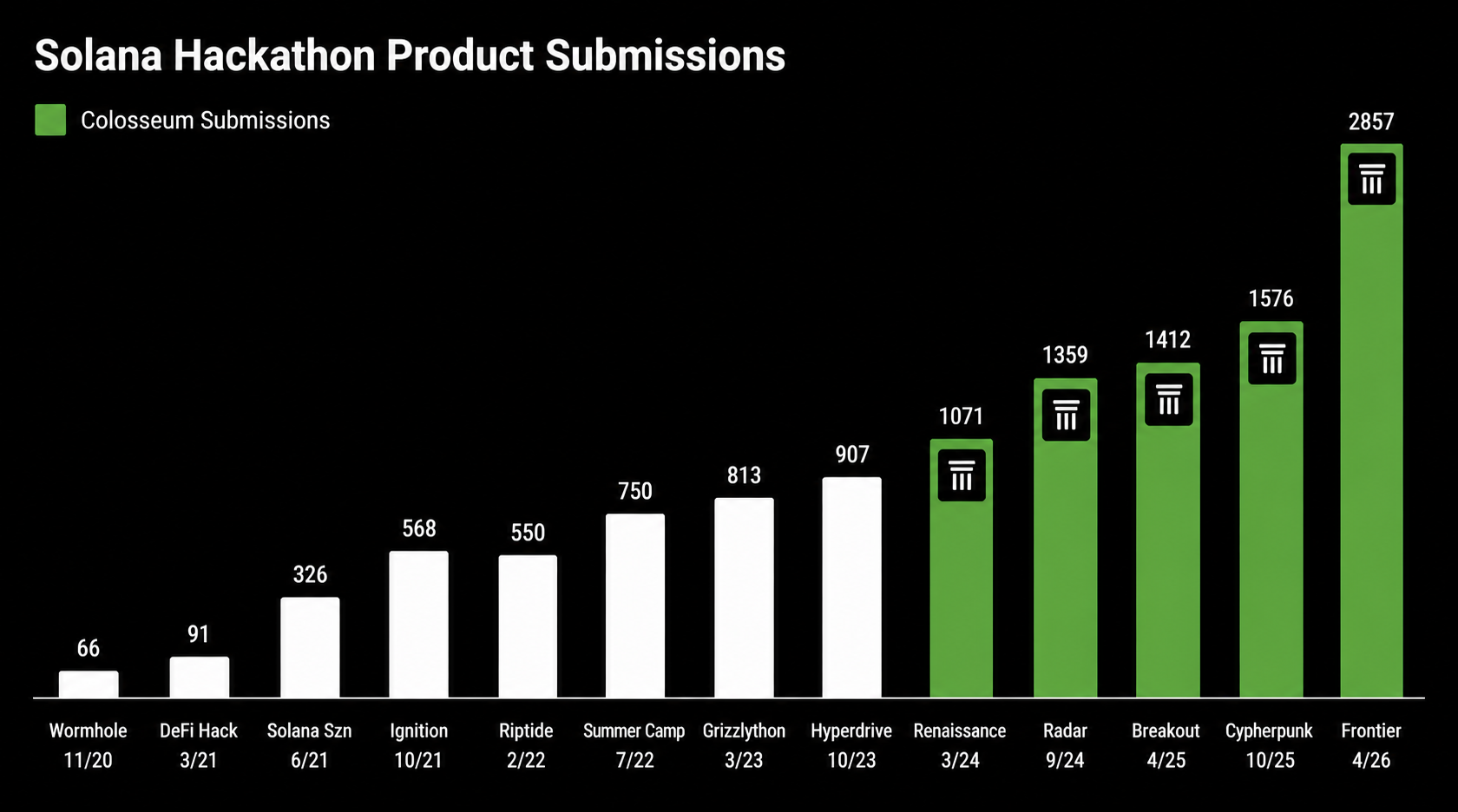
This means that AI is also making starting a startup far more competitive. When prototyping and shipping is fast for everyone, competition floods into any visible opportunity within weeks. The landscape is unforgiving: the moment you prove a market, the field becomes crowded. Speed of founding and speed of competition have risen together, which means the winners need to execute on truly insightful product ideas with the right tools, the right connections, the right judgement, and the right capital behind them.
Equipping Founders, Discovering Outliers
In the Age of AI, a venture firm has to do a few things well: identify the rare talent worth backing amid an overwhelming amount of noise, support those founders at key inflection points, and grow sharper with every investment.
With this in mind, @n8levine and @mxmnci have shipped a series of features to the Colosseum platform over the past few months that map onto the critical stages of founding an AI-era startup, in addition to wiring our entire organization with AI tooling to help us discover investable talent more effectively.
- Colosseum Copilot is a research skill that turns your AI coding agent like Claude, Codex, and OpenClaw into a crypto startup analyst, with access to 8,000+ past hackathon submissions, 84,000+ curated crypto/tech documents, troves of academic research, and key learnings from the history of startups.
- Cofounder Matching connects serious crypto founders across skill sets, commitment level, timeline, and location. A startup broken at its foundation cannot easily be fixed, and the team is the real moat in the age of AI.
- Our platform also enables AI agents to plug directly into Colosseum. Last February, we ran an experimental agent-only hackathon where autonomous agents registered, formed teams, built real Solana products, and humans voted on the results. The insights from it shaped the comprehensive skills file we now offer (npx skills add ColosseumOrg/colosseum-resources), letting agents plug straight into the Colosseum platform and fetch key developer resources.
These tools (and others in development) lower the barrier to building, so more founders enter our hackathons and more products ship than ever before. That abundance creates a new challenge on our side: finding the rare outliers in an ever-larger pool of submissions. So we built an internal evaluation engine in response. It filters the thousands of submissions we receive, scores each project across the components that tend to predict a breakout, including founder-market fit, product velocity, user demand, market timing, evidence of grit from their past, and surfaces the spiky green flags we've learned to spot over years of working with top founders. It plugs into every team call, team message, founder interview, and internal document. It is our very own Cerebro, scanning for the next great founder the moment they enter the arena.
The founders who we identify through the hackathon platform are selected to join our accelerator, an SF-based program built around connections: mentorship, an elite founder network, and warm introductions to customers and follow-on investors. The program also offers substantial discounts on AI subscriptions, thanks to our friends at OpenAI and Anthropic.From there, our venture fund capitalizes them. The economics of early-stage funding have changed: with AI reducing the need for early hires and making software far cheaper to build, founders now reach meaningful milestones on less capital than before. Our standard investment is meant to provide founders necessary seed capital, without restrictive dilution or more cash than the moment requires.
Expanding the Arena
Venture returns follow a power law: a handful of companies return more than all the others combined. The conventional response is to get better at picking those few out of a fixed pool. We believe the more powerful and far more positive-sum strategy is to again take inspiration from the Volta Prize. Our goal is to enlarge the pool itself, growing the number of crypto founders capable of becoming outliers in the first place. Everything above, from the founder tools to our internal review product to our accelerator program, exists to do exactly that.
It is also why the signals we act on look nothing like a pitch deck. We watch thousands of teams ship real products, under pressure, for five weeks. So by the time we interview a team, we are acting on weeks of evidence about who iterates, who listens to users, and who is creating something genuinely innovative. As @crabbylions says, we source from the weird corners of the internet, finding and nurturing founders others miss or overlook.
This is the benefit of building the whole arena rather than any single piece of it. Founding, acceleration, and funding are connected stages of one motion, each strengthened by AI. Like Bell, we treat the prize as a beginning rather than a finish line, carrying the breakthroughs that emerge in the arena forward into startups, and the best of those startups into the institutions that will change the world.
Godspeed to all builders entering the arena, and I'm sure @mrinko would like to discuss this article with you at the upcoming @MetaDAOProject Owners Meeting at our San Francisco office.