Colosseum Codex: Q2 Token Holder Report, Kit v7, Mithril
Blockworks Q2 Token Holder Report, Solana Kit v7 React Hooks and Transaction Introspection, Mithril Validator, Rome EVM on Solana

This week makes it clear that Solana's non-speculative demand is maturing. The Blockworks Q2 Token Holder Report shows how tokenized equities, stablecoins, and payments are becoming the growth story as memecoin mania dies down. The builder side is also accelerating with Kit v7's React layer, Rome opening up EVM builds, and the Mithril Go validator working its way towards mainnet.
🔥 Q2 Token Holder Report
Blockworks Research published its Q2 2026 Solana Token Holder Report, and the signal for builders is clearer than the headline revenue numbers suggest. Non-speculative demand grew through a declining market while memecoin-era activity kept draining out.
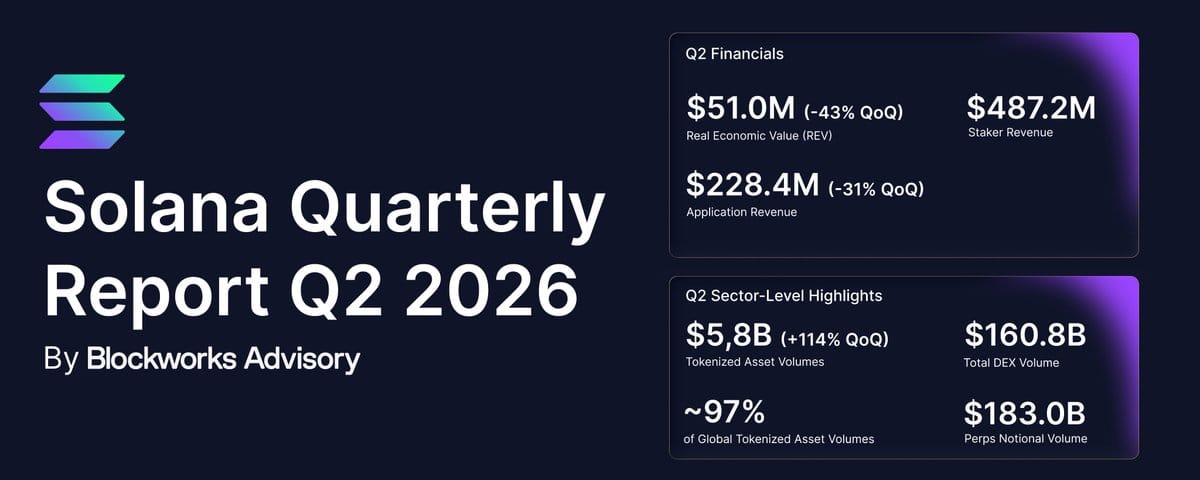
Tokenized asset volume hit an all-time high of $5.8B, up 114% QoQ, led by tokenized equities at $4.8B (a fourfold jump from Q1). June alone did $3.3B in equities volume, catalyzed by the June 12 SpaceX listing, with tokenized SPCX doing roughly $770M.
Solana now handles about 97% of tokenized-equity trading across all chains. The same rails that absorbed memecoins absorbed equities at record scale. Prop AMMs began quoting tokenized assets and already represent an estimated 50% of that volume.
The cyclical half reset hard with REV fallingl 43% to $51.0M. Application revenue fell 31% to $228.4M, and DEX volume fell 44% to $160.8B, though June rebounded 26% month over month on tokenization, not memecoins.
Alpenglow, Solana's largest protocol upgrade to date, is targeted for Agave v4.2 around August. Prerequisites have already shipped:
- Agave v4.0 cut block replay roughly 3x (~130ms to ~50ms)
- p-tokens (SIMD-266) went live in mid-May with ~95% CU reductions on standard transfers
- SIMD-525 staged slot times from 400ms toward 200ms.
On the economic layer, SIMD-123 would give stakers an in-protocol claim on priority fees (now 60% of REV), while SIMD-550 (faster disinflation) and SIMD-553 (usage-linked burn) debate the supply side.
Google Cloud and the Solana Foundation launched Pay.sh for AI-agent micropayments, AWS shipped a stablecoin system for monetizing AI traffic, and Mastercard, Western Union, and SoFi all moved settlement onto Solana.
The memecoin craze just battle-hardened Solana for a new demand curve for tokenized equities, stablecoins, payments, RWAs, and financial primitives that don't need a bull market to exist.
⚛️ Solana Kit v7
Anza released Kit v7, the latest version of its TypeScript SDK and the successor to web3.js, adding a first-class React layer and a transaction-decoding package.
The new @solana/react package cuts data-fetching boilerplate with new hooks:
useRequest: Fetch on mount with manual refreshuseSubscription: Real-time streams with reconnectionuseTrackedData: Combines an initial fetch with a subscription for continuously updated values like account balancesuseAction: Wraps async functions with dispatch, loading, and error state
It ships integrations with TanStack Query and SWR through dedicated import paths. Underneath sit framework-agnostic "reactive stores" exposing a minimal subscribe/getState contract, and every Kit RPC call now has a `.reactiveStore() `method.
A separate @solana/transaction-introspection package turns raw RPC transaction responses into typed Kit Instruction objects, resolving account lookup tables and normalizing inner instructions.
Decoding raw transactions has always been the ugly part of building explorers and indexers. This gives builder a shared, typed foundation instead of having to ship their own one-off decoders.
Kit v7: Introducing React Hooks and Transaction Introspection
🛡️ Mithril Frodo Validator
Overclock released Mithril v0.1.0-frodo, its independent Solana validator client written in Go, now running as an active validator on the Alpenglow testnet. The client produces blocks, votes, and runs full Alpenglow consensus.
The milestone builds on an earlier preview that showed Mithril producing its first blocks. Since then the team completed voting and the rest of Alpenglow consensus. A live Mithril validator is currently running on a modest server (AMD Ryzen 7 Pro 8700).
Overclock was clear that testnet is not mainnet. Handling real traffic, including spam and adversarial load, will take more performance, feature, and auditing work.
Core features still to implement include snapshot production, Turbine retransmit (ingestion already works), other networking and repair updates, broader hardening, and block builder integrations.
Client diversity has always been one of Solana's real risks, so another independent client making progress towards full consensus is a big step forward!
Mithril now an active validator on Alpenglow testnet
🏛️ Rome Protocol Goes Open
Rome is an EVM execution environment embedded directly in Solana's runtime, letting developers deploy Solidity contracts alongside native Solana programs against shared state.
Instead of a bridge, Rome keeps EVM contracts and Solana programs operating on the same data, and Solidity can call Solana programs directly through CPI. It supports standard EVM tooling like Hardhat, Foundry, and MetaMask, so developers write conventional Solidity without learning Solana-specific patterns.
The project has now open-sourced its apps, contracts, SDK, and chain registry, with refreshed docs to match. There are four ways to build on it:
- Deploy an existing EVM app: Deploy an existing EVM app on Rome and tap Solana liquidity with no Rust rewrite.
- Expose a Solana program to EVM users: Open a native program to EVM users through CPI.
- Start greenfield: Scaffold a cross-VM "dual-lane" app in one command on the Rome SDK.
- Bring your users: Give your chain's users native Solana access with one pool and both wallets.
Each path has a demo devnet app and public repos.
⭐ Highlights
Why the weekly Solana Changelog is so important - @readylayerone
The 2nd best source of weekly Solana developer news 😄
One Account Type to Rule Them All: Anchor V2's Slab and the Duplicate-Mutable Check - Frank Castle
A deep dive into Anchor v2's duplicate-mutable account check works, and a bug that can reject valid transactions.
Turbine Advanced SVM Capstone Project Showcase - Turbine
Capstone demo product spanning SVM rollups, Kernels, eBPF, zkVMs, Agave and more.
Regulating Permissionless Blockchain: An Open Letter to the FCA - SRI
The Solana Research Institute is urging the UK's FCA and other regulators to write rules based on how permissionless blockchains actually work
⚡ Quick Hits
▶️ Solana Summer School: Solana x AI with Dev Bharel - Solana
Solana builder reading list - @solana_stream
Solana Tokenized Assets Hit Record $5.8 Billion in Q2 - Crypto News
▶️ 4 Ways to Store Lists of Data in Solana Programs - @QuicknodeSolana
From Building a Personal Brand to Building Solana’s Spanish Ecosystem - @Allenbaez126
Backfilling and hosting the Solana Ledger, a two-part guide on getting started - @triton_one
Stablecoins are now on Ramp and settled on Solana - Ramp
Solana Changelog: July 23 - @solana_devs
Want early access to the latest products launching from Colosseum?
We're looking for alpha testers to be among the first to try what we're building!
⚙️ Tools & Resources
n8n-nodes-solana-signer - A keychain-based Solana node that lets you get a wallet address, derive PDAs, build transactions, get an unsigned base64 transaction, and sign and send, all inside n8n.
pinoc check - A linter for Solana safety bugs that compile clean and that rustc and Clippy never catch. v0.2.1 ships the first version of zero-copy layout lints, with account, signer, and CPI checks planned next.
confidential-sdk - An open-source TypeScript SDK for Token-2022 Confidential Transfers on Solana, keeping balances and amounts encrypted on-chain and decryptable only by the owner. v1.0 is available on npm alongside a Rust crate.
solana-dev-skill - A revamped set of Solana AI skills that work with any coding agent. It keeps all versions up to date, lets you test against mainnet risk-free with Surfpool, and aims to one-shot most Solana apps.
solgate-cli - A CLI that lets Windows developers run Solana and Anchor commands in PowerShell at Linux speed, bypassing the WSL bottleneck that slows down builds.
sentio-rs - An AST-based security scanner for Anchor programs, written in Rust. It uses the syn parser to analyze code structure and catch 22 vulnerability classes, including missing signer checks, arbitrary CPI targets, unchecked arithmetic, and type cosplay, with no build step or source upload.
💓 Ecosystem Pulse
🚨 Flash Trade loses $98K to an exploit - The root cause was an incomplete validation path in MagicBlock's #[ephemeral] Anchor macro, which checked the undelegation buffer's signer and owner but not that it was the expected PDA.All affected users were fully reimbursed, and integrators should upgrade to SDK >= v0.16.2.
🚨 Allbridge Core loses $1.66M in a flash-loan swap exploit - Same-asset swaps let an attacker exploit the swap logic of Allbridge Core's Solana liquidity pools. Only LP pool liquidity was hit, and Allbridge is now sunsetting pool-based swaps in favor of CCTP and LayerZero routes.
🎧 Listen to This
MetaDAO Inaugural Ownership Meeting
Colosseum and MetaDAO released the videos from the inaugural MetaDAO Owners Meeting, a full set of talks and panels recorded live on July 10, 2026, at Colosseum's San Francisco office.
It captures the first formal gathering of MetaDAO owners, founders, and investors working through ownership coins and futarchy-based decision markets as ways to get better token alignment and accountability on Solana.
The keynote highlight is Dr. Robin Hanson, who originated futarchy, explaining how prediction markets aggregate information and improve collective decisions, summed up as vote on values, bet on beliefs.
Other core talks include Proph3t's History of MetaDAO, Kevin Heavey on asset-price versus KPI-based markets, and Noah Goldberg on the practical trading of decision markets.
Notable sessions also cover:
- Supply Chain of Capital — Clay Robbins: How capital is sourced, filtered, and deployed via hackathons, accelerators, and funds.
- How Investors Underwrite Ownership Coins: Panel with investors from Theia, Colosseum, and Ownership Ventures on diligence, valuation, and risk.
- Fundamentals Data for Ownership Coins: The importance of transparent, high-quality financial and operational data.
- Accounting challenges and standards: Why opacity is priced as risk and the push for open financial records.
- The Future of Umbra: Keynote on the project’s trajectory within the ownership-coin ecosystem.
These sessions cover the theory behind the futarchy model, MetaDAO's own history, how capital gets raised, and how investors actually think about it.
MetaDAO Inaugural Ownership Meeting
📅 Event Calendar
Colosseum Demo Day: Accelerator Cohort V, San Francisco, CA, Aug 26
Colosseum hosts its first in-person demo day, where 21 teams from the Frontier Hackathon pitch after eight weeks building in San Francisco. Doors open at 10:00 AM with pitches starting at 11:00 AM, followed by a founder mixer lunch. Registration requires host approval and is aimed at investors, operators, and builders in the Solana ecosystem.
👩🔧 Get Hired
- Anza is hiring a Senior Software Engineer, Block Production
- Temporal is hiring a Data Engineer
- Phantom is hiring a Staff Software Engineer, Full Stack
- Akash Network is hiring a Senior Full Stack Engineer
Kit v7, Rome, and Mithril validator updates all landed the same week the report says the growth is real. Which of these actually changes what you'll build next quarter, or is none of it moving your roadmap yet?
Thanks for reading ✌️
Follow me on X!