Colosseum Codex: Frontier Hackathon, Copilot, Constellation MCP
Frontier Hackathon, Colosseum Copilot AI Assistant, Constellation MCP Whitepaper, Solana Developer Platform, Quasar Program Development Framework, MoonPay Open Wallet Standard


Here's what's featured in this week's issue:
- Colosseum announces the Frontier Hackathon
- Colosseum launches Copilot research skill for AI coding assistants
- Anza publishes whitepaper for Constellation to introduce Multiple Concurrent Proposers
- Solana Foundation launches Solana Developer Platform
- Blueshift releases the Quasar Solana program development framework
- MoonPay open-sources the Open Wallet Standard
🏆 Frontier Hackathon
Colosseum has announced Frontier, the next global Solana Hackathon, running from April 6 to May 11, 2026.
Sign ups are open now. Tracks, prizes, and sponsors will be announced soon.
🤖 Colosseum Copilot
Colosseum released Copilot, a research skill that turns AI coding assistants into Solana startup analysts. It gives agents access to 5,400+ hackathon submissions with tech stacks and competitive context, 84,000+ archived documents from 65+ curated sources, 6,300+ crypto products via The Grid, and live web search.
Unlike a general-purpose LLM, Copilot is built to be honest about competition. If another team is already building the same thing, it says so with the project name, hackathon, and what they've shipped. When incumbents exist, it classifies the gap as full (nobody has addressed this), partial (incomplete coverage by segment, UX, geography, or pricing), or false (already solved).
Answers must also meet evidence floors: a market assessment requires builder project data, at least one archive citation, and current landscape evidence. If it can't meet the floor, it says so rather than speculating.
It runs in two modes:
Conversational handles quick lookups with inline citations.
Deep Dive ("vet this idea" or "full analysis") runs an eight-step workflow through parallel data gathering, archive search, incumbent validation, gap classification, and a structured report covering revenue model, GTM strategy, founder-market fit, and risks.
The archive draws from cypherpunk mailing lists, Satoshi's emails, Nick Szabo's essays, Solana Breakpoint transcripts (2022–2025), and research from Paradigm, a16z, Multicoin, Pantera, Galaxy, and more.
Copilot is free for all Colosseum members and only requires generating a personal access token.
🌌 Constellation MCP
Anza published a whitepaper for Constellation, a proposed protocol change that replaces Solana's single-leader-per-slot model with multiple concurrent proposers (MCP) operating in parallel 50ms cycles.
The design gives Solana what Anza describes as the fastest protocol-enforced, censorship-resistant economic tick rate of any decentralized blockchain in production.
Today a single leader controls which transactions get included and in what order for the duration of their slot. Constellation distributes that role across multiple proposers per cycle, with inclusion guarantees enforced by the protocol rather than validator goodwill or off-chain commitments. If enough attesters have seen a transaction proposal, inclusion in the next execution cycle becomes mandatory.
Transaction ordering moves from discretionary to deterministic: transactions are ranked by priority fee per compute unit and assigned to a parallel execution schedule, with overflow rolling into the next cycle, making ordering verifiable by every validator.
Validator economics shift in one notable way: ordering fees are distributed across the entire validator set by stake weight rather than accruing to the slot leader. Inclusion and priority fees remain, and validators still build blocks, but no single validator captures ordering revenue through leader position.
Anza notes this also prevents self-payment attacks where leaders manipulate their own fee capture. Constellation is designed as a preprocessor to Alpenglow and a SIMD is forthcoming.
Solana Constellation: Fair Internet Capital Markets
🛠️ Solana Developer Platform
Solana Foundation launched the Solana Developer Platform (SDP), an API-driven platform for enterprises and financial institutions to build financial products on Solana. SDP aggregates infrastructure from 20+ ecosystem partners into a single unified interface designed for compliant, scalable deployment.
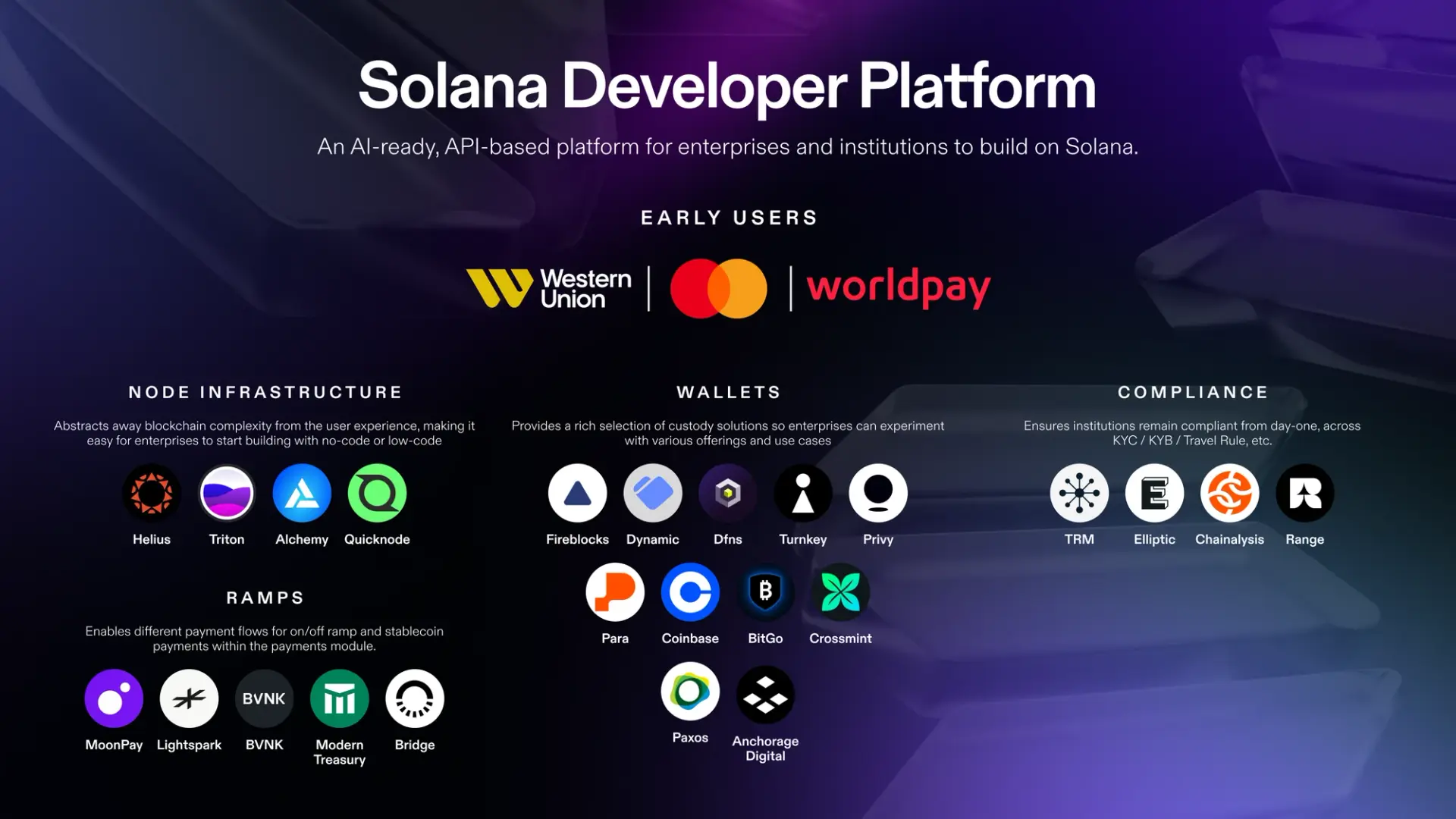
The platform ships with three modules:
- Issuance: Tokenized deposits, GENIUS-compliant stablecoins, tokenized RWAs
- Payments: Fiat and stablecoin flows including on/off-ramp, B2B, B2C, and P2P
- Trading: Atomic swaps, vaults, onchain FX
The issuance and payments modules are live today on Solana devnet with the trading module planned for release later in 2026.
Infrastructure partners include node providers, custody wallets, compliance, and ramps. Early enterprise users include Mastercard (stablecoin settlement), Worldpay (merchant payments), and Western Union (cross-border payments).
Developers can access a sandbox environment on Solana devnet now. SDP is also compatible with AI coding platforms including Claude Code and Codex.
Solana Foundation Launches Solana Developer Platform
🌟 Quasar Framework
Quasar is a Solana program framework from Blueshift that delivers near-hand-written compute unit efficiency while keeping the familiar Anchor developer experience. Programs run no-std by default and accounts are read directly from the SVM input buffer with no deserialization, no heap allocation, and no copying.
The framework preserves Anchor's attribute-driven style of account constraints, PDA seeds, bump derivation, initialization, and closing all work the same way. The main conceptual shift is that mutability is expressed in the type signature rather than an attribute.
CPI calls use a method-chaining style that eliminates manual context construction. PDA signing is handled by auto-generated seed helpers on the bumps struct, removing the need to build seed arrays by hand. Dynamic account data uses zero-copy bounded types stored inline in account memory rather than heap-allocated strings and vectors.
Migrating from Anchor is designed to be incremental. The attribute model is intentionally identical, so most of the work is updating imports, adding explicit discriminators, and converting CPI call sites.
The CLI generates typed TypeScript clients for both @solana/web3.js and @solana/kit from the program IDL, along with a Rust client crate.
Quasar Solana Program Development Framework
👛 Open Wallet Standard
MoonPay open-sourced the Open Wallet Standard (OWS), a multi-chain protocol that gives AI agents and developer tools a single interface for storing keys, managing wallets, and signing transactions across all major blockchains.
The project launched with 21 founding organizations including PayPal, OKX, Ripple, Solana Foundation, DFlow, and Circle, several of which are already integrating OWS into their SDKs.
The core problem OWS addresses is that payment protocols like x402 and MPP define how agents pay but say nothing about where private keys live or how they're protected.
OWS replaces this with a single encrypted vault on the local filesystem. One BIP-39 mnemonic derives accounts for all supported chains via standard HD paths, keys are encrypted with AES-256-GCM and decrypted only to produce a signature, held in locked memory, and zeroized immediately after use.
OWS is CC0-licensed and available today.
Introducing OWS, the Open Wallet Standard
Want early access to the latest products launching from Colosseum?
We're looking for alpha testers to be among the first to try what we're building!
⚡ Quick Hits
Perps on Solana: The Missing Link - @therealchaseeb
Build a Solana Kit Plugin for Quicknode Priority Fees API - Quicknode
Privacy on Solana: A Full-spectrum Approach for the Modern Enterprise - Solana Foundation
Agent Skills: Pre-built skills for AI agents building on Solana - Solana
The new Anchor v1.0.0 Release Candidate is out - @solana_devs
Solana program-examples updated to the current Solana, Anchor, Borsh and web3.js - @QuicknodeSolana
Delay Tolerant Networking and Solana Transaction Propagation for Offline-First Payments (PDF) - Zypp Labs
I Participated in 4 Colosseum Hackathons. Won 0. Here Are My Key Lessons. - @mango_
Introducing the Light Token SDK for Payments - @LightProtocol
⚙️ Tools & Resources
quasar is a no_std Solana program framework. Accounts are pointer-cast directly from the SVM input buffer with no deserialization, no heap allocation, no copies.
cvct is a confidential, vault-backed token system for Solana that issues private claims on SPL assets, with per-user balances and supply encrypted via Arcium MPC.
mpp-sdk is a Solana payment method for the Machine Payments Protocol that supports native SOL and SPL tokens, split payments, fee sponsorship, and replay protection.
realms-agent-docs are Agent skills for interacting with the Realms platform on Solana. Compatible with OpenClaw and any agent framework that supports the AgentSkills spec.
Jupiter CLI is an early alpha CLI for interacting with Jupiter's products on Solana, including Spot, Perps, Lend, and Prediction Markets.
RustTraining includes seven training courses covering Rust from different programming backgrounds, plus deep-dives on async, advanced patterns, and engineering practices.
👩🔧 Get Hired
- Solana Foundation is hiring a Head of Data
- Very AI is hiring a Full Stack Engineer
- Sphere is hiring a Software Engineer (Operations)
- Quicknode is hiring an Ecosystem Intern
📅 Event Calendar
Ship Week v3, Miami, FL, May 4-10
A week of co-working, technical talks, and Solana-focused events. May 5 aligns with Solana Accelerate and Consensus 2026. The week closes with a party on May 8. Registration and acceptance required. Sponsors and venue to be announced soon.
🎧 Listen to This
The Stack
The Stack is a new developer-focused podcast from the Solana Foundation, hosted by Ilan Gitter, Head of Ecosystem Engineering. Each episode features technical deep dives with engineers building on Solana.
The debut episode features Chase Barker, formerly of the Chewing Glass podcast, who shares his journey into the Solana ecosystem, insights on building on Solana, and the future of decentralized finance including perpetual futures and ecosystem support strategies.
Chase Barker - Solana Foundation
Follow me on X!
Thanks for reading ✌️
I hope you found something useful here! If you have any suggestions or feedback just let me know what you think.